Prof. V.V. Serdyuk
Based on two scientific discoveries of Professor V.V. Serdyuk
If we look at one another, including members of our families, as well as friends, neighbors, and others, we will be greatly surprised to see that all of us, without exception, have spinal deformities of varying degrees of severity, namely scoliotic posture with the formation of a rib hump. The degree of this deformity varies considerably from person to person and depends on lifestyle, profession, type of work, age, and other factors.
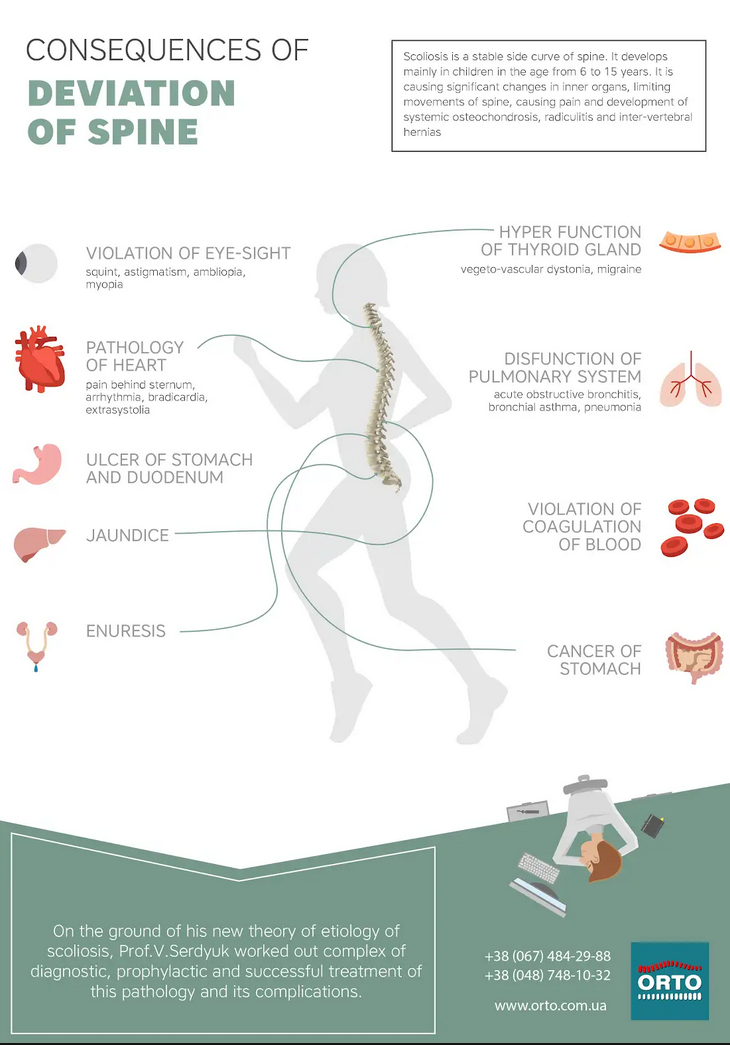
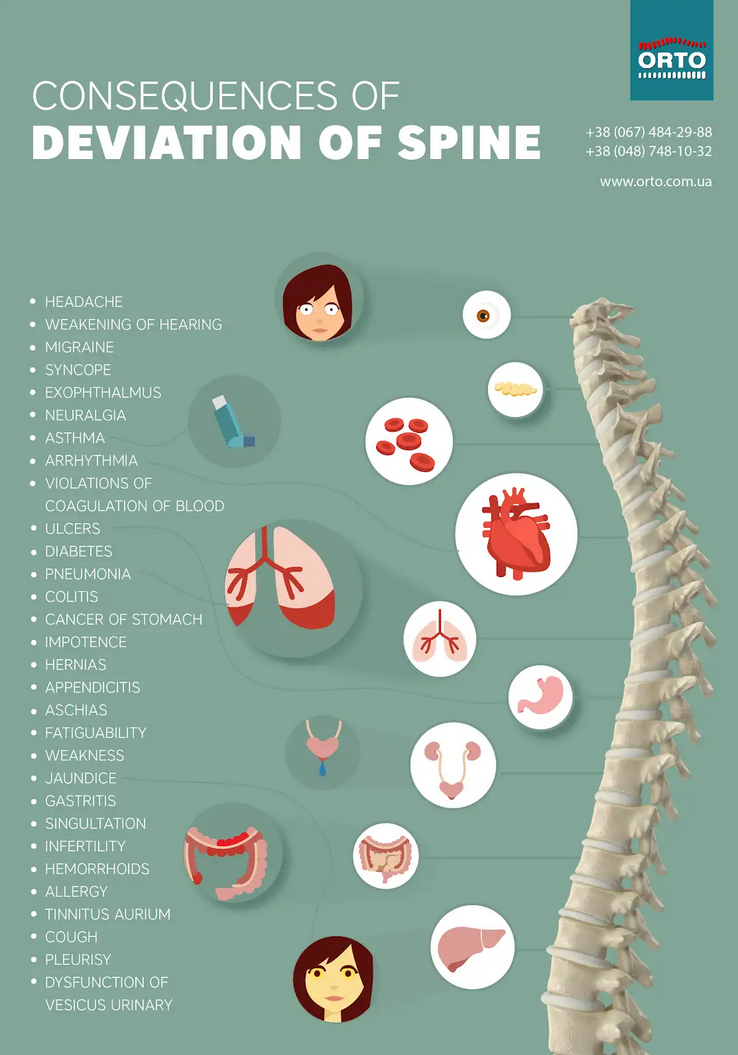
The complaints presented by patients are extremely diverse: headaches, more often unilateral, dizziness, pain in the heart region, impaired hearing and vision, vegetative-vascular disorders, numbness and spasms of the fingers and toes, and pain in various parts of the spine. Rapid physical and mental fatigue may occur, as well as radicular pain resembling intercostal neuralgia, with localization in the region of the heart, stomach, kidneys, and other organs.
A very important fact is that the formation of spinal deformity in childhood is practically asymptomatic. As a result, the physician often examines the patient for the first time not as a child, but already as an adolescent or even as an adult. By that time, the patient has clear symptoms of pathological spinal deformity, as well as symptoms of internal organ diseases caused by impaired innervation. It should be stated from the outset that in this situation we are not referring to infectious or oncological processes, which undoubtedly require specific treatment.
Based on a new theory of the development of scoliotic deformity, Prof. V.V. Serdyuk developed a complex of diagnostic, preventive, and therapeutic measures for the early detection and successful conservative treatment of scoliosis, as well as related disorders:
The use of this new complex from early childhood until the completion of active skeletal growth is aimed at restoring spinal-pelvic balance, physiologically correct biomechanics of the trunk muscles, and preventing the transition of functional scoliosis into structural scoliosis. This complex includes detorsion gymnastics exercises, the use of an orthopedic shoe insert on the side of pelvic tilt, and magneto-acoustic stimulation of the spinal cord.
As a result, full blood supply to the spinal cord is restored, and consequently, the proper functioning of the conductive pathways and spinal nerves is restored. This leads to the normal functioning of all tissues, organs, and systems.
The accumulated knowledge made it possible to look at the problem of scoliosis development and spinal pain in a non-standard, new way. This allowed recommendations to be developed for their treatment not only in children with initial forms of disease, but also in adults with chronic pathological processes.
The use of the new therapeutic complex in adult patients, combined with physical exercises aimed at preserving spinal elasticity, significantly reduces the symptoms of vertebrogenic thoracalgia and, in particular, cardialgia. In this way, it prolongs a person's state of physical health for many years. The complex is absolutely safe and harmless and is not associated with medication intake or surgical intervention.
The new conservative method of treating scoliosis is most effective in early childhood. The harmonious development of children creates a real prospect of reducing the number of adult patients. The use of Prof. V.V. Serdyuk's discoveries in clinical practice opens the way to improving patients' health with a minimal amount of medication, or even without medication at all. The proposed complex is protected by patents of Ukraine and Russia. Its effectiveness has been confirmed in thousands of patients suffering from scoliosis and spinal pain syndrome. The effectiveness of the treatment is enhanced by physiotherapy, specifically magnetotherapy, delivered by magneto-acoustic devices designed by Professor V.V. Serdyuk.
A follow-up observation period of more than 20 years among patients treated according to the method of Prof. V.V. Serdyuk allowed him to draw a number of important conclusions.
The use of the complex proposed by him, consisting of detorsion gymnastics, a corrective shoe insert, and magneto-acoustic procedures, makes it possible to eliminate scoliotic posture or functional scoliosis in children and adults relatively quickly when it is caused by unilateral spasm of the back extensor muscles. The existing pelvic tilt is eliminated, the axis of the spine becomes correct, and the back becomes straight. The speed of correction of scoliotic posture ranges from several months to a year or more and depends on the initial degree of relative shortening of one leg and on the presence or absence of dysplastic elements in the lumbar and sacral vertebrae.
A correctly selected shoe insert prevents possible progression of lateral spinal curvature. At the same time, it does not merely mechanically raise the pelvis to the required horizontal level. Information about the change in body position is analyzed by the vestibular apparatus and then fixed in the cerebellum as a new "correct" reflex of the vertical body position.
The second stage of treatment should be correction of the spinal skeleton and resection of the rib hump, that is, elimination of structural scoliosis. The traditional approach is surgical intervention, namely fixation of the vertebrae in the maximally corrected position using various metal structures. However, due to a number of difficulties, including the traumatic nature of the operation itself, after which spinal growth practically ceases, postoperative complications, high cost of treatment, and other factors, brace treatment has been increasingly used in recent years.
Surgical correction and fixation of the body with a brace are aimed at immobilizing the spine in the most correct possible position and preventing deterioration of the process. The main objective is to prevent the condition from worsening.
The second stage of treatment proposed by Prof. V.V. Serdyuk is based on the continued performance of his therapeutic complex over a number of subsequent years. During this period, a slow restructuring of the spinal skeleton takes place without external intervention. Such self-correction of the vertebral bodies and ribs against the background of corrected posture naturally occurs faster in children, beginning from an early age and continuing until the completion of active skeletal growth. In adults, whose skeleton is already fully formed and who retain structural defects of the vertebral arches, processes, ligamentous apparatus of the vertebrae, and other structures, restorative processes proceed extremely slowly, over 2 to 5 years or even longer.
From the standpoint of biomechanics, surgical treatment and brace treatment do not and cannot provide a pronounced therapeutic effect without the first stage, namely elimination of pelvic tilt and spinal instability in the lumbosacral motion segment caused by unilateral spasm of the back muscles. It is precisely the persistence of pelvic tilt that causes fractures of metal fixators due to metal fatigue.
Thus, the necessity of correcting scoliotic posture as the first and most important stage in the treatment of scoliotic disease becomes clear.
In most cases, the main cause of lateral curvature of the spine is asymmetry of the back extensor muscles. Pelvic inclination due to unilateral spasm of these muscles, combined with elements of underdevelopment of the lumbosacral vertebrae, disrupts spinal-pelvic balance and becomes the trigger for the formation of scoliosis. The severity of this deformity depends on the degree of relative shortening of one leg inherited from the parents.
A curved spine traumatizes all parts of the spinal cord (including its brainstem-related structures), nerve endings, ganglia, and other structures. This disrupts the normal functioning of both the brain and all organs and tissues. All these changes begin in early childhood and gradually increase. Thus, children with functional scoliosis grow into adult patients with deformed backs, various diseases, and pain syndrome.
If scoliotic posture is not corrected in early childhood, then later, in adolescents and adults, functional scoliosis transforms into structural scoliosis. This form is characterized by changes in the anatomical structure of the vertebral bodies, including wedge-shaped deformity, underdevelopment of the arches, processes, ligaments, discs, muscles, and other structures.
A persistent fixation of the spine in a position of inclination to the right or left, which is characteristic of all people regardless of sex and age and is caused by congenital unilateral spasm of the back extensor muscles, initiates rotational displacement of the vertebrae in all spinal regions: cervical, thoracic, lumbar, and sacral.
Rotation of the cervical vertebrae causes extravascular compression of the vertebral arteries and veins, as well as the sympathetic nerves passing through the vertebral foramina. This leads to impaired arterial and venous blood supply to the brain. Insufficient arterial blood flow leads to cortical atrophy, memory impairment, delayed intellectual development, up to autism in children and senile dementia, Alzheimer's disease, in adults. Impaired venous outflow from the brain, causing increased intracranial pressure, leads to enlargement of the cerebral ventricles, up to hydrocephalus, seizures, epileptiform attacks, and other disorders.
According to Prof. V.V. Serdyuk, these disorders are the causes of migraine development — frequent and prolonged headache attacks, not only in adults but also in children of all ages, predominantly adolescents. A sharp turn of the head to the right or left, upward or downward, may often result in short-term loss of consciousness, which is extremely dangerous while walking outdoors, driving a car, or working with rotating machinery. Fluctuations in blood pressure, tearfulness, irritability, restless superficial sleep, or chronic insomnia are also associated with impaired arterial and venous circulation.
These are, in general, the causes of vegetative-vascular dystonia and vertebrobasilar syndrome, which often lead patients to disability. Thanks to an understanding of the mechanisms underlying the development of these pathological conditions, Prof. V.V. Serdyuk provides sufficiently effective assistance up to recovery, with minimal medication or even without medication. Thousands of treated patients confirm the correctness of this direction of medical care.
It is the impairment of blood supply to the brainstem that causes hearing loss, as well as hormonal disorders, including cachexia and its opposite, obesity, and various disorders of sexual development. Early detection of these changes in children opens the way to improving their health and preventing future disability.
Dysfunction of the medulla oblongata and spinal ganglia is a frequent cause of strabismus and trigeminitis. Their successful treatment has been carried out by Prof. V.V. Serdyuk together with pediatric ophthalmologist Alexandra Nikolaevna Komashko since 2002, using their joint inventions: "Method for the Treatment of Strabismus," Patent of Ukraine No. 48900 A, and "Method for the Treatment of Inflammation of the Trigeminal Nerve, Trigeminitis," Patent of Ukraine No. НХ 024.
Even more complex changes occur in the lumbar and sacral spine. Elderly patients often come to Prof. V.V. Serdyuk with a vast number of diverse complaints, including pain throughout the body, numbness of the hands, persistent pain syndrome in the lumbar and sacral regions, pain in the joints of the lower limbs, and others. Yet even in such seemingly hopeless situations, ways can be found to reduce the intensity of pain syndrome and return the patient to an active and full life.
A small but quite encouraging experience has already been accumulated in the treatment of bronchial asthma and diabetes mellitus in childhood and adolescence. There have also been cases of successful treatment of psoriasis, seborrhea, obesity, and infertility.
A detailed presentation of everything stated above, including more than 120 cases from the clinical practice of Prof. V.V. Serdyuk, with descriptions of X-rays and computed tomography scans, as well as recommendations for further treatment, is provided in the monograph "Body Asymmetry. Scoliosis. Spinal Pain Syndrome. A New View of an Old Problem."
In 5% of all scoliosis cases, there may be fractures, inflammatory processes, poliomyelitis, tuberculosis, and other conditions. Idiopathic forms, in which the cause of the disease is unknown, account for 95% of cases. Functional and structural scoliosis are classified among them.
Functional scoliosis is characteristic of children and adolescents and is caused by spasm of the back muscles. My method — compensation of the functional shortening of one leg through the use of a shoe insert, a complex of derotation gymnastics, and local magneto-acoustic therapy — makes it possible to cure this form of scoliosis within several months without the use of a brace or surgery.
Structural scoliosis develops as a result of anatomical restructuring of the vertebrae, namely their wedge-shaped deformity. Correct body positioning can also lead to correction of this form of scoliosis, but this process takes several years. The body shape is corrected even if the wedge-shaped form of the lumbar vertebrae remains. Patient histories confirm this.
When we speak about scoliosis, treatment of idiopathic scoliosis is usually carried out either by wearing a brace or by fixation of the spinal column with metal structures. In children under 15 years of age, operations are not performed because of the possible impairment of skeletal growth. Therefore, surgery should preferably be performed after the age of 15 to 16 years.
THE NEW, HIGHLY EFFECTIVE AND COMPLEX METHOD FOR TREATING SCOLIOSIS, DEVELOPED BY PROF. V.V. SERDYUK, ELIMINATES THE NEED FOR SURGICAL INTERVENTION AND BRACE WEARING. IT IS BASED ON RESTORING PHYSIOLOGICALLY CORRECT BODY BIOMECHANICS AND PREVENTING THE TRANSITION OF FUNCTIONAL SCOLIOSIS INTO STRUCTURAL SCOLIOSIS.
The use of the proposed complex (detorsion gymnastics, a corrective shoe insert, and magneto-acoustic procedures) in the treatment of children with infantile scoliosis (up to 3 years of age) and juvenile scoliosis (from 4 to 10 years of age) makes it possible to effectively correct scoliotic posture, functional scoliosis, caused by unilateral spasm of the back extensor muscles, pelvic muscles, and thigh muscles. As a result, lateral curvature of the trunk is corrected, the spinal axis becomes correct, and the back becomes straight.
Thus, the earlier we restore the correct position of the spine in children, preferably at the age of 1 to 3 years, the faster we make them healthy. No matter how advanced the surgical procedures developed for the treatment of scoliosis may be, they are aimed at correcting already existing complex and progressive forms of this pathology. We call for using the information presented on the website and in the books to declare war on scoliosis and the diseases associated with it, while remaining determined to win by applying new methods of prevention and conservative treatment.

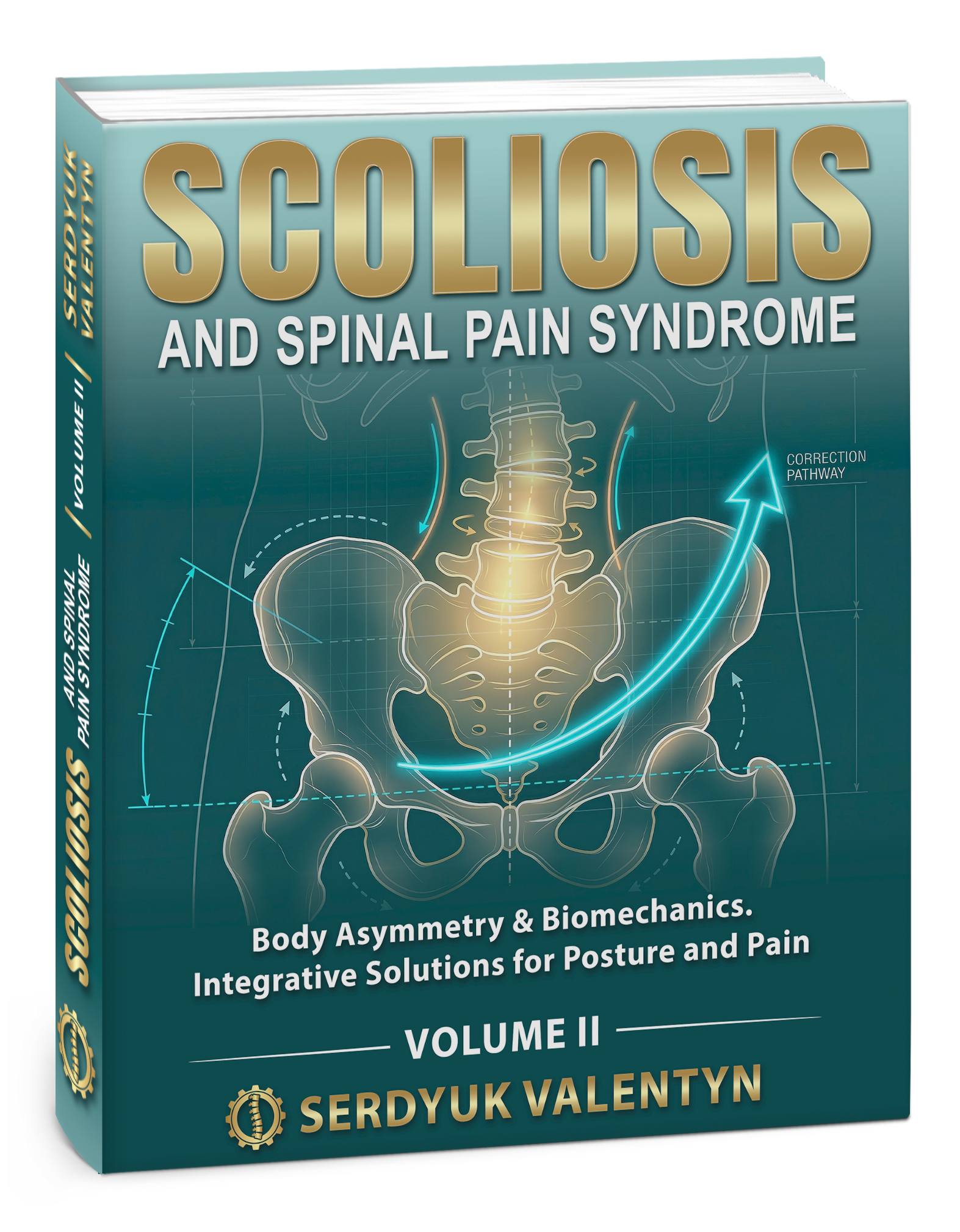
Volumes I & II — Body Asymmetry & Biomechanics, Integrative Solutions for Posture and Pain. For adults, parents, and clinicians seeking a more coherent framework.
Millions of children and adults suffer from idiopathic scoliosis and spinal pain. The author presents two discoveries explaining both scoliosis and many related diseases. Over 25 years, the author treated more than 10,000 patients.
This book is available for purchase on Amazon in both electronic (eBook) and PaperBack formats.
 Buy on Amazon